
ACECQA quality ratings explained for Brisbane parents
By Mei Larsen · Updated 2026-07-28
This is general information about how the ACECQA quality rating system works, not a substitute for checking a specific centre’s current, official rating.
You’ll see “ACECQA Exceeding” mentioned in plenty of Brisbane centre reviews and marketing, but it’s worth understanding what that rating actually represents before you weigh it heavily in your decision. It’s a genuinely useful data point, just not the whole picture.
What ACECQA actually assesses
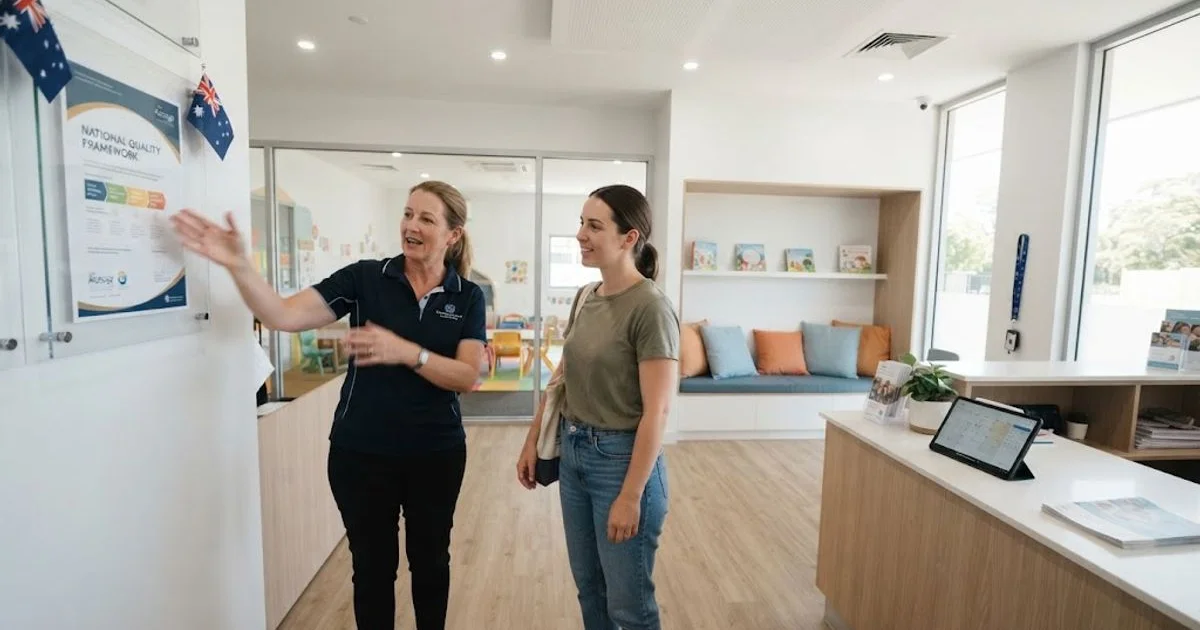
The Australian Children’s Education and Care Quality Authority (ACECQA) oversees the National Quality Framework, which every approved childcare service in Australia is assessed against. Assessors evaluate a centre across seven quality areas, covering things like educational program and practice, children’s health and safety, staffing arrangements, and governance and leadership. Based on that assessment, a centre receives an overall rating.
The rating levels
| Rating | What it means |
|---|---|
| Excellent | A small number of exceptional services awarded this status directly by ACECQA, on top of an Exceeding rating |
| Exceeding NQS | Goes beyond the standard in most or all of the seven quality areas |
| Meeting NQS | Meets the national standard, a genuine pass against a rigorous framework |
| Working Towards NQS | Assessed as not yet meeting the standard in one or more areas, generally with an improvement plan in place |
| Significant Improvement Required | The lowest rating, indicating serious gaps requiring urgent action |
Ratings are published against each of the seven quality areas individually as well as an overall summary, so it’s worth looking past the single headline rating if you can. A centre might carry an overall Meeting rating while still Exceeding in the specific area you care about most, such as educational program or health and safety, and the detailed breakdown on the official register shows this level of nuance that a single badge doesn’t.
A “Meeting” rating is not a red flag. It reflects a centre that satisfies a genuinely high national bar; “Exceeding” simply means the assessors found it went further in most areas at the time of assessment.

Why the assessment date matters
Ratings aren’t reassessed on a strict annual cycle, so a centre’s current published rating could reflect an assessment from a couple of years ago. A lot can change in that time: staff, management, even ownership. Always check the assessment date alongside the rating itself on the official ACECQA register, rather than assuming a badge on a website reflects last month’s visit.
How much weight to give it
Treat an ACECQA rating as one solid input among several, not the deciding factor on its own. It tells you how a centre performed on a structured, point-in-time assessment across a broad framework, but it doesn’t tell you whether your specific child will settle in well with the specific educators in their room today. Pair the official rating with a recent tour, direct conversation with staff, and recent parent reviews before deciding.
It’s also worth knowing that many genuinely good centres carry a Meeting rating simply because they haven’t been reassessed since improving, or because “Exceeding” requires a specific, formal level of documentation and practice that a smaller or newer centre may not have built out yet, even if the day-to-day care is excellent.
Where to check
Search the official ACECQA National Registers directly for a specific centre’s current status and assessment date rather than relying on secondhand claims. It only takes a couple of minutes and gives you the most accurate, up-to-date picture.
Using the rating alongside your own research
A sensible approach is to use the ACECQA rating as an initial filter, useful for narrowing a long list of options, then spend your actual decision-making time on tours, direct conversation, and recent parent feedback for the centres that make your shortlist. Two centres with the same overall rating can still feel very different once you’re standing in the room watching how educators interact with the children, and that’s the detail no published rating will ever fully capture. Use the official data to open doors, not to close them without a visit.
Compare Brisbane centres and their published ratings on the directory, using our methodology for how we weigh ratings alongside review data.
Questions people ask
- What does an ACECQA Exceeding rating actually mean?
- It means a centre has been formally assessed against the National Quality Standard and found to be exceeding the standard in most or all of the seven quality areas, rather than simply meeting the minimum benchmark.
- How often are centres reassessed?
- Assessment timing varies and isn't on a strict fixed cycle for every centre, so a rating can be a couple of years old. Always check the assessment date on the official ACECQA register rather than assuming a rating is brand new.
- Does a lower rating mean a centre is unsafe?
- Not necessarily. 'Meeting' the National Quality Standard is still a genuine pass against a rigorous framework; it simply means the centre hasn't been assessed as going beyond it in most areas. A meeting rating is not the same as a compliance concern.
- Where can I check a specific centre's current rating?
- The official, most current source is the ACECQA National Registers, searchable by centre name or location. Don't rely solely on a rating badge on a centre's own website or marketing material, since it may not reflect the most recent assessment.